Showing posts with label Recognition Week. Show all posts

Sunday, October 10, 2010

A Salute to Heroes

 Today marks the fifth of five installments of Letters to Pilky's first Recognition Week, where we here at LtP recognize those who, well, deserve recognition.

"Remember kid, there's heroes and there's legends.  Heroes get remembered, but legends never die." - Babe Ruth, the Sandlot (If you actually needed that citation, I'm extremely disappointed)
Can you believe there isn't a picture of Ruth's ghost in Smalls' room on the internet?
From the first time I heard the above quote, I was sure that it only meant one thing: be a legend, become immortal, do things that nobody else has ever done (ok, that's three things, but how lame is the phrase, "I was sure that it only meant three things").  Now, I'm sure that this is not only impossible, but that I would never want to encounter a situation where it was possible. 

People don't become legends.  Moments become legendary.  Legends come about because of things that heroes do that will never be forgotten, that will be passed on until the end of time.  The 300 at Thermopylae weren't legends, but their stand is a moment that has become legendary.  Paul Revere wasn't a legend, but his ride is a moment that became legendary.  Babe Ruth wasn't a legend, but when he pointed his bat over the center field fence at Wrigley Field, he created a legendary moment.  Neil Armstrong wasn't a legend, but when he stepped onto the moon he created a legendary moment.  The 1980 U.S. hockey team wasn't made up of legends, but when they beat the Russians they created a legendary moment.

These are moments that stand out forever in time.  Moments that you can mention offhandedly and everyone will know what you're talking about and where they were when it happened.  Legends aren't people, but situations.  Snapshots in time.  Images that make us awestruck and proud and amazed all at the same time, no matter how involved we are or were in the situation.
I'm fairly certain that all of you know exactly what this was.
Heroes are just people who stand out further and shine brighter than everybody else.  This doesn't mean that they have to stand out to everybody, just to whoever it is that they're a hero to.  They have their faults and their downsides, but they're still important enough in the lives of some where it doesn't matter that they mess up, because the ups and downs are what make them human.  Would we really look up to our heroes if they were legends?  They'd be totally unreachable: impossible to grasp, impossible to comprehend.  Would we go out into our backyards and our basements and pretend to be them hour after hour, day after day, year after year in our childhoods?  Would we sit at our desks and wonder, "What if?" as we approach adulthood?  We'll tell our kids about the legendary moments because they are a part of our culture, but they're distant, they're not personal.  We have relationships with our heroes.  Heroes make us cry.  Heroes make us dream.  Heroes make us downright giddy.  Heroes aren't larger than life, they are a part of life.
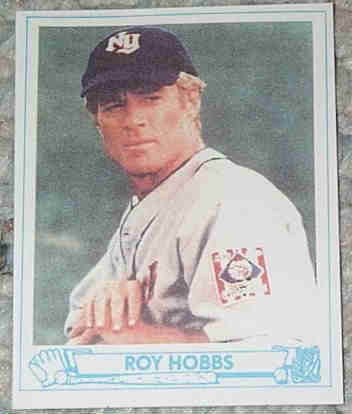
"When I walked down the street people would've looked and they would've said there goes Roy Hobbs, the best there ever was in this game"
The Babe had it right in The Sandlot, legends are immortal.  Legendary moments never end.  Heroes, however, are the ones that get remembered.  They are remembered as people, they are remembered as real, they are remembered as much for who they are as for what they did and as much for the times that they made us cheer as for the times that they made us cry.  Moses killed a man, Thomas Jefferson and FDR slept around, Mickey Mantle was a drunk, Michael Jordan is an asshole.  Nobody is perfect, but they don't have to be.  These people accomplished great things, incredible things, things that nobody thought could be done.  Can you honestly say that they aren't good heroes, or that you haven't looked at them in a hero's light?

If heroes were perfect in every regard, nobody would look up to them in the way that we do.  It would be impossible to replicate them or even outdo them from the time that we made our first mistake.  We would respect them and admire them, but we could never be them, and the possibility of being them is what's so beautiful and so terrifying and so incredible about having a hero.  If they were legends, they'd be perfect, and perfection is impossible to replicate.  This is why legendary moments are legendary.  They are perfect.  They can't be changed.  Perfection is possible, but only for brief moments in time, and they are so rare that when they do happen they are impossible to forget.
"This team is perfect. We stepped out on that field that way tonight. And, uh, if it's all the same to you, Coach Boone, that's how we want to leave it."
Heroes aren't perfect, they can't be.  They brush perfection and then lose it, but for every time that they are that close to it there is another time that they couldn't be farther away.  Both types of moments seem to last forever, but heroes are able to accept that.  They know that glory is fleeting, but they know that disappointment is too.  Anybody can be bold when they hit that high, but true courage shows up when they hit the low.  These are the people that we look up to.  These are our heroes.

I believe that labeling a person as your hero is the greatest compliment and the greatest statement of love that can be made.  I know this because I have heroes, and they are the people that I respect most.  Jim Thome is on that list.  Ben Folds is on that list.  So is Howard Roark.  But above them are my brothers and my parents and my grandparents, my coaches and my friends.  These are the people who have influenced me.  These are the people who have qualities that I wish I had.  These are the people who I love

So here's to heroes, both those who have created legendary moments that the world knows and those who are only a hero to one person.  Thank you for being real.  Thank you for being attainable.  Thank you for showing us that even though we can't be perfect forever there's no reason why we shouldn't strive for perfection anyway.

Friday, October 8, 2010

A Salute to Hockey Players


Today marks the fourth of five installments of Letters to Pilky's first Recognition Week, where we here at LtP recognize those who, well, deserve recognition.


If the world was run by hockey players, I'm convinced that it would be a better place.  Here's why:

1.  They have an amazing ability to put things in perspective

While driving back from South Bend after moving Michael out, I was listening to Game 4 of the Western Conference Finals, the game in which Blackhawks defenseman Duncan Keith got his teeth knocked out by a slapshot.  He only left the game for about five minutes, but after the period they provided a pretty good interview with another player (I'm pretty sure it was Brent Seabrook, but I'm not positive.  We'll assume it was).  They asked him whether he thought Keith would be able to contribute very well for the rest of the game, to which he responded by saying (rather nonchalantly), "Oh yea.  Dunk's a good tough hawkey playur, ya know?  Kind of a leetle beet of a, uh, rough break dare, but, uh, ya know, he should be ready to go for dee uh, duh rest of duh gayme."

What??

This man just got a quarter of his teeth taken out, and it's no big deal?  There are professional baseball players who get put on the disabled list for blisters.  Basketball players get rested all the time for tweaked hammies.  This man was bleeding profusely from the mouth, had his fricken teeth shattered, swallowed some of them, and nobody's worked up about it?  These guys can take a hit.

This is exactly why we'd be set if they were put in charge of running the world.  There's some bad stuff going on out there, even stuff that rivals getting seven teeth shattered by a hockey puck traveling close to 100 miles per hour (I know, seems improbable).  Seriously though, the world of politics is a cheap-shot ridden, no holds barred, kill or be killed dogfight, and some stuff that seems pretty horrible has to be put into context.  Hockey players are used to getting beaten up.  They have to get beaten up consistently for 20-25 minutes per game.  Studies have shown that football games only have 15 minutes of action in them, so that's 7.5 minutes for offense and defense, and they get a full 40 seconds between hits.  Hockey players get checked and hit with sticks pretty much for minutes at a time, all without losing sight of a little puck being whipped around the ice.  If these guys were in politics, I feel like they would definitely be able to take things in stride, without getting too upset about them, all while still being able to keep things in perspective and keeping their eyes on the goal (pun not intended, but pretty unavoidable).

2.  Hockey Players are willing to accept roles

Quick, who is this man:
I'm willing to be that unless you're a serious hockey fan, you don't know.  But I bet you do know who this is:
The bottom one is Wayne Gretzky, the greatest hockey player of all time.  Who is the top one?  None other than Dave Semenko, one of the greatest goons in NHL history, and the man who, in part, gave Gretzky the ability to become the greatest hockey player of all time.  Basically, anybody who tried to hinder Gretzky's progress immediately got the crap beaten out of them by our boy Semenko, which pretty much gave Gretzky the ability to do whatever he wanted on the ice.

"But Young William," you ask, "What does this have to do with running the world?"

Basically, everybody needs to learn how to accept the roles that they're put into.  Dave Semenko was never going to be as skilled of a scorer as Wayne Gretzky, and he knew that, but do to Gretzky's limited stature, he would have been rocked every time he stepped on the ice if he didn't have a little help.  Semenko knew he wasn't going to get the glory (although he did gain quite a cult following), or any of the records, but he was able to be extremely valuable to his team through his ability to beat people up.  In the real world, very few people get the glory, and problems arise when the people who don't get the glory wish they did, become jealous, and try to undermine the entire system.  (Anytime the word "undermine" is used, you know things aren't going to end well)  We need people who are willing to accept their roles, no matter how much external recognition they receive, because it will improve the overall good.  If we had less people in congress trying to get their own agendas realized, and more people trying to figure out how to get our money back, I think we'd be more than a little better off.

3. They have a quick and easy way of solving problems

In the real world, problems generally take way longer to solve than they should.  There's a pretty much generally accepted solution, which is ignored, lots of discussion, which eventually comes back to the solution which had been proposed in the first place, more discussion because the losing party doesn't want to accept the solution, more discussion, and finally they come to terms which more or less resemble where they already were.

In hockey, they fight, and it's over.  Quick, easy, and simple.  If these guys ran the world, conflicts would be over and done with within a matter of minutes.  No more war, no more court cases that take years to resolve, these guys would pretty much just lay down the law and it would be over and done with.  Period.  Game over.

4.  Hockey players are extremely low maintenance

These guys basically need nothing to keep them happy.  You never hear about hockey players getting upset about terms of a contract, they never hold out, they pretty much just accept their worth and live with it, and if they don't like it they try to improve it.  This is basically the way that America was built into the most successful country in the world.  The founding fathers (should that be capitalized?) didn't like their situation so they changed it.  Henry Ford didn't like his situation so he improved it.  Martin Luther King Jr. didn't like his situation so he changed it.  They didn't whine for the sake of whining, and largely they take care of their own problems.  Instead of talking about their problems and wondering why they don't change, they don't talk about it and fix it.  I can't believe that anyone can possibly argue that this wouldn't be an improvement.

Wednesday, October 6, 2010

A Salute to Howard Roark

Today marks the third of five installments of Letters to Pilky's first Recognition Week, where we here at LtP recognize those who, well, deserve recognition.

Whenever I'm in doubt about just about anything, I think about what this man would do:
Wait a minute...
Your first thought may have been that this man is God, and while I often think about what God would want me to do in many situations, I have trouble ever actually doing what God would do (mostly because I lack the ability to create the world, create any type of species, flood the world, change myself from spiritual form to human form, burn a bush without it actually burning, or part any bodies of water), so instead, I look to Howard Roark.  "But Young William," you ask, "who is Howard Roark, and why does he look so pale in the picture you just posted of him?"  Well, Howard Roark is a fictional character from an incredible novel called The Fountainhead, by Ayn Rand, but before you start questioning my sanity if I'm relying on a guy who doesn't even exist to lead my life, I'd like to give you a little bit of background information: (Deep breath...) Howard Roark is what he calls a "prime mover," which basically means that he makes decisions based on his own personal preferences and opinions, rather than what other people pressure him to do.  He is an architect, and is directly contrasted to a man named Peter Keating, who always succumbs to the pressures of meeting social norms and doing what other people to do.  This method of action works out early for Keating, who gets a high paying job out of college but does menial work, while Roark has a hard time finding work because he refuses to do a job where anybody else influences his work.  He believes that his ideas are great, and he doesn't want them to be watered down by others.  Roark is totally content with his life throughout the novel, even though he lives in shabby apartments and has a very low living standard.  Keating, with his nice job and its cushy benefits, ultimately realizes that he is just a puppet for his boss and his customers.  He isn't an architect because he takes great pride in his buildings, but rather because he likes these benefits, while Roark is rewarded by every job he receives, because he takes great pride and joy in his work.  To quote Roark: "Before you can get things done, you must be the kind of man who can get things done.  But to get things done, you must love the doing, not the secondary consequences.  The work, not the people.  Your own action, not any possible object of your charity.  I'll be glad if people who need it find a better manner of living in a house I designed.  But that's not the motive of my work.  Nor my reason.  Nor my reward."

Ayn Rand became an author only after her modeling career didn't work out.
 A recent poll of all people sitting at a northwest window seat of the 12th floor of the library while wearing a 2008 IHSA Baseball State Finals t-shirt, who were given the option of whether different adjectives described Roark came back in this way:
Poll may or may not be scientific
Basically, Roark was happy because he was always doing exactly what he wanted to do.  he was never compromised in any way.  Obviously, this didn't mean that he was always making money, always employed, or always had a full stomach, but it did ensure that he would never regret anything that he did, which very few people can say that they did.  We all look for external validation for our actions, but why?  Will people really respect us more if we decide to always do what they want us to do?  I don't think so.  I think it is much more impressive for someone to stand up for what they believe in, and who they are, even if it means going against the flow or receiving little support.  This also makes success that much more rewarding when it finally does come, because we know that we are fully responsible for it, and it came in a way that we are truly proud of and truly believe in.  Roark didn't allow his ideas to be watered down, and allowed the realizations of these ideas to be the only reward he needed.  He never did something just for a paycheck, or just for recognition.  As he mentions in the earlier quote, he's not opposed to external validation at all, and in fact is in favor of it, but he will never allow for it to be his only motivator.  We all know Peter Keatings; people who will never do anything unless it's supported by the general opinion, or who will immediately look around after they accomplished something because they want people to see how cool they are, but who never go out and do something just for the sake of doing it.  It's impossible for us to totally avoid these things, as we are all social animals, but there really isn't a reason that these types of sentiments should dominate our lives.
I'm pretty sure these guys didn't do this to prove how cool they were.
Long story short, the people that I most respect are Roarkians, and the people I least respect are Keatingians (also known as attention whores).  Thome plays ball for a small salary, in a small market, without much noise, because he loves playing ball, while LeBron James seems to be playing in hopes of blowing himself up into a combination of Michael Jordan, Paris Hilton, and Khloe Kardashian.  Folds plays music he loves, in a style he loves, even though he'll never be as big as the artists who sell themselves out.  William Golding wrote Lord of the Flies, which sold no more than 3000 copies before initially going out of print.  he must have known it would be controversial, and he surely could have found something more popular to write, but he wanted to write his way, because that's something that he was passionate about.  Mother Theresa could have been a televangelist and reaped attention (and money) from around the world, but she did what she loved and was passionate about, and went to Calcutta.  These are the kinds of people that we all respect.  These are the kinds of people that we emulate.
Definitely worth reading.
So here's to you, Howard Roark.  Thanks for showing us it's more important to love something than to be noticed for it.  Thanks for showing us to never let The Man run us down.  Thanks for showing us that we'll always be happy if we stay true to ourselves.  Thanks for showing us that there's nothing wrong with being misunderstood by others as long as we understand ourselves.  And thanks for proving that the most successful people aren't the ones with the most money at the end of the day, or the most fame at the end of the day, or the highest number of successes at the end of the day, but rather those who are able to take the most pride in, and gain the most happiness from, their success.

Tuesday, October 5, 2010

A Salute to Ben Folds

Today marks the second of five installments of Letters to Pilky's first Recognition Week, where we here at LtP recognize those who, well, deserve recognition.


The greatest rock pianist since Billy Joel is this man:
Insert joke about illegal pirating of music here.
Ben Folds is a man that I don't think gets enough love.  With guitar-based music dominating the rock scene for most of the '80s and '90s, Ben Folds has been able to have quite the career through his piano-based music (which my iTunes tells me is either Soft Rock (Rockin' the Suburbs), Rock (Songs for Silverman, Way to Normal), or Alternative & Punk (Supersunnyspeedgraphic), but I'm pretty sure I'd throw Jazz in there too).  Not only is he unique in this regard, but he has also managed to avoid conformity in pretty much every regard.  Folds is quoted as saying that, "Rock and roll is - and should be - a kid's place," and from my experience as a fan I can say pretty confidently that he has stuck to this statement throughout his career.  (In fact, his music keeps getting more and more "out there," as opposed to heading towards any one distinct subgroup in the rock and roll field)  The only other artist that I would group in the alternative/rock/soft rock piano field would be Ben Kweller, and he and Ben Folds collaborated (along with Ben Lee) on a tour through Australia in what may go down in history as the second greatest "If you can't beat 'em, join 'em" musical effort, only behind Billy Joel and Elton John's recent tour.  They labeled themselves "The Bens" (so uncreative it almost seems creative) and even put out an EP, labeled (wait for it)...(seriously, this is brilliant)..."The Bens" (I know, incredible).  All kidding aside though, I dare you to dislike this song: Bruised - The Bens.  That's our boy on bass in the beginning, Ben Lee on guitar, and Kweller on the drums, and they sound pretty good, but when Folds shifts to the piano, to quote AnotherRainyDay11's (could they have chosen a more emo name?) comment, "it is pure magic."
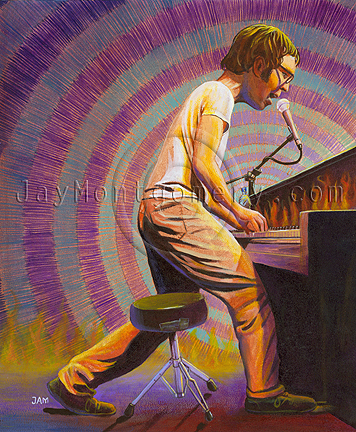
Seemed like a good time for a watercolor.  Props to Jay Montgomery, whoever you are.
The cool thing about piano music is that there are so many more options than a guitar.  You can play up to ten individual notes, or one or two chords and a note, or two chords, or one power chord, all at the same time.  Plus there's a huge range, and you can have a definite melody while still providing a harmonic bass line.  Killer, brah.  (Speaking of such, Ben Folds would probably appreciate this.  Otherwise, how could he possibly explain this video?)  Anyway, this harmony is what Folds' music is all about.  He rarely has exceptionally powerful lyrics and even though he has the potential to turn into a jam artist, he hasn't taken advantage of that.  Start listening to this: Late - Ben Folds.  There are about 4-5 things going on musically all at once.  Folds voice, the bass, the bass line on the piano, the piano melody, and even the drums, which seem to be doing more than accompanying him, all create some serious depth to the song.  Now try this one:  Army - Ben Folds (Live).  He even describes the multiple musical lines going on at once at the beginning of the song.  "But Young William," you say, "Every band has multiple instruments.  How can you say that Ben Folds is any better than anyone else?"  Good question.

Here's Ben Folds' answer:  "White people don't sing together very often, and when they do, it's about the celebrity of the song.  The singing at my shows is about harmony."
Black people, on the other hand, do sing together well, and often, and with stellar harmony.
 Here's my answer:  Ben Folds puts everything together at once.  While other bands might have great solos with not much going on in the background, Folds has figured out a style that seems to combine a bunch of solos.  Listen to this: Fair - Ben Folds Five.  Besides having one of the best album covers ever, it has a gazillion different things that by themselves could all be solid solos, but they're all layered on top of each other.  There's piano, bass, jazz drumming, a fricken xylophone, Folds lead singing, the background harmony singing, electric guitar, and probably some other stuff that I missed.  If you focus on a different instrument every time the song will still be interesting every time, which is very cool.  This is why Ben Folds is a type of utility artist.  His music can be played in just about any situation, can be featured or be background noise, and falls into a bunch of genres, so it's really hard to dislike everything that he does.  Very few artists are this versatile.  I'm not a great musical historian, but I'd consider myself decent, and I believe that there was nobody like Ben Folds before him, and I have a hard time believing that anyone will be able to replicate his style after him.  He's very free-flowing, doesn't really care what other people think about him (Always Someone Cooler Than You - Ben Folds), and is a master of about 47 different instruments (not really, but close).  So here's to you, Ben Folds.  Thanks for not conforming.  Thanks for not giving a shit about what we think.  Thanks for bringing back music in an age of synthetic pop.  Most of all, thanks for reminding us that, "the piano is just a different animal.  It's expensive, it's big, it's heavy, and it doesn't fit in the mix easily.  Everyone grew up with a piano in their living room, so rocking out on the piano was accessible - it wasn't an upper-class thing.  Now pianos have become very much a piece of furniture."  Hopefully there's some young bespectacled rebel doing just that right now.

Monday, October 4, 2010

A Salute to Jim Thome

Today marks the first of five installments of Letters to Pilky's first Recognition Week, where we here at LtP recognize those who, well, deserve recognition.

When I was little, the only thing I ever wanted to be was Jim Thome.
Mostly because of his striking good looks
Jim Thome was larger than life to young six year-old William when he led the Indians to the American League championship in 1997.  I always made sure that he was the "Star Player" in Hardball 5, and after my Albert Belle shirt wore out, his #25 was the second Indians jersey I ever had (and one of the best birthday presents of all time.  Too bad it doesn't fit anymore... I wouldn't mind another one... Good thing you can make custom jerseys on mlb.com... Take note, family).  He was (and is) a country-strong, home run hitting machine, and I'm confident that nobody has ever had more fun on a baseball field than he has.
Seriously, have you ever seen somebody this happy?
When my brother and I were little, we would always play tennis ball baseball in the sideyard.  It was always Indians vs Orioles, recreating the 1996 ALDS and the 1997 ALCS.  We would take the lineups out of Outside Pitch, give me a 3-0 lead in the series, and play out the rest of the series (I'm pretty sure my record was something like 1-97 in those things, which means I won 1 game and lost 387, but boy was that one victory glorious).  We would bat lefty for lefties and righty for righties, so in theory every player was the same, but I never felt more confident than when Big Jim Thome came up in the 7-hole. (Tangent:  The Indians were loaded in '97.  Bip Roberts, Omar Vizquel, Manny Ramirez, David Justice, Matt Williams, Sandy Alomar, Thome, Tony Fernandez, Marquis Grissom.  Rotation of Nagy, Hershiser, Ogea, Colon, and Wright.  Jose Mesa out of the pen.  How did we ever lose a game?).  I'm pretty sure that he batted close to .700 in those games (probably not really, but it felt like it).  Anyway, more than any other athlete ever has been (sorry Casey Blake), Jim Thome was my idol.

This was the best decision I have ever made.

Jim Thome used to just be a ballplayer to me, and there was nothing wrong with that.  Hundreds of guys are "just ballplayers" to the public.  They go onto the field, play the game, and go home, and we know nothing about them except for some stats, and maybe the memory of a Web Gem or walkoff homer they had.  
Paul Assenmacher - solid reliever, but pretty much just a ballplayer
As I've grown up, and my baseball appreciation has matured, I have come to realize that Jim Thome is more than just a ballplayer.  He is a role model.  In an age where many athletes worry about promoting their individual "brands" or trying to bring in as much money as possible, Thome is quietly becoming one of the best hitters of all time.  He is currently 8th all-time in home runs, only 20 behind Sammy Sosa, and 39th all-time in RBIs.  Disregarding players who have been linked to steroids (Sosa, A-Rod, and Bonds), Thome would be in 5th, in the company of Hank Aaron, Babe Ruth, Willie Mays, and Ken Griffey.  He is so humble, however, that many people forget about just how good he has been for such a long career.  His teams have a winning percentage of .540 for his career, which speaks to his skills as a player, but also speaks to his skills as a teammate and as a person.  He always has a smile on his face, he is always enjoying himself, and he always knows that his team will come out on top.  As anybody who has ever played organized sports knows, this type of attitude is contagious, and definitely will never hurt a team's ability to win.
Plus he has mad hops
In a game where failure is so prevalent, Thome is an eternal optimist.  He has 2395 career strikeouts, good for 2nd most all-time among hitters, and his lifetime batting average is .278.  He gets out a lot, but he always seems to not only think that he'll get a home run his next time up, but know that he'll hit one.  Last week, Sports Illustrated ran an article on Thome in which he was quoted as saying "Something special is always just about to happen. You've just got to believe it."  This is a man who is paying to put all ten of his nephews and nieces through college, whose nephew is paralyzed after suffering a spinal injury, and who lost his mother, one of his best friends, recently.  Circumstances don't phase Jim Thome.  Is there any better mindset than this?  It's applicable in everything.  It eliminates all potential excuses.  Whenever anything goes wrong, he always looks forward to the next opportunity.  Notice also how he uses the word "special" as opposed to "good" or something along those lines.  Imagine a life where you're always looking forward to that special occurrence.  No wonder he always looks so giddy.

A few weeks ago I wrote about how those who are hated have reached the top of their game.  I issued an addendum after my brother pointed out that those who truly transcend their field are too good to be hated.  He used the Beatles as an example, and I'd like to use Jim Thome.  Sure there are a few boo-birds in Cleveland when he comes back after leaving in 2001, but I find it hard to believe that anybody truly wants him to fail after all that he has done for the game.

If you don't see a resemblance, please stop reading

Looking at Jim Thome has always made me think a little bit of Babe Ruth.  The high socks, the baggy jersey, the chubby, clean-shaven face, the paunch of gut.  The Babe was larger than life, and to me, at least, so is Jim Thome.  So here's to you big man:  Thanks for never cheating.  Thanks for never giving up.  I hope that you finally find that World Series championship that you so rightly deserve.  That would really be something special.